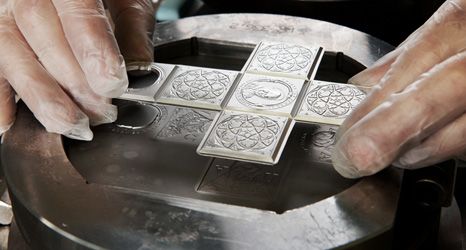
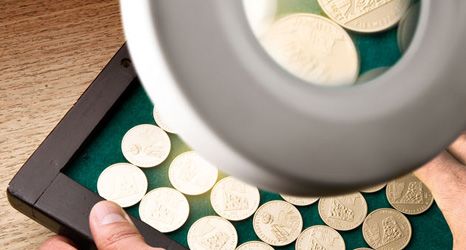
The third set of coins of the Polish National Symbols series, presenting the most important regalia.
The Polish Mint presents an unusual set of coins, third of the “Polish National Symbols” series. The series presents seven images of the most important regalia, such as:
• the Lance of St. Maurice
• Szczerbiec – Coronation sword
• Casimir the Great’s burial crown
• Ladislaus Jagiello’s crown
• Sigismud III Vasa’s crown
• August III’s coronation crown
• Coronation crown of Polish Rulers
The coins are packed in an elegant wooden case, which also includes a certificate of authenticity. Each set has individual numbering on the edge of each coin and on the certificate.
On the cover of the case there is an unusual replica of the Bene Merentibus medal, which King Stanisław August Poniatowski awarded to all the most eminent and merited persons.
The majesty of Poland in its regalia
The prestige and majesty of a country once depended on whether it had a rank of a kingdom. Granting the right to a crown meant recognizing country’s sovereignty, raising the country to the level of other crown countries and including the ruler in the group of royal courts (as a Christian monarch), functioning in the political and cultural space, whose legal and religious borders were in Europe determined by popes and emperors.
The attributes of royal dignity were the regalia and their representations on coins, stamps and coats of arms, especially on the first one – the crown. Kings’ subjects focused around this symbol, it also represented state majesty outside the country. The following expressions were in use: “The Crown of St. Louis” – used in reference to the Kingdom of France – “The Crown of St. Wenceslaus” – defining the Kingdom of Bohemia, Moravia, Lusatia and Silesia – “The Crown of St. Stephen – meaning the Kingdom of Hungary - and the Crown of the Polish Kingdom (Corona Regni Poloniae) – the full official name of our country since the 14th century. By hand of Bolesław the Brave, as early as in 1025 Poland was included in the symbolic family of European kingdoms. For centuries, they cultivated and developed rituals, and introduced objects that distinguished the crowned persons, legitimizing their power and rights. They included: crown, scepter, orb, sword, epaulettes and ring. They were the property of state, not the ruler. The insignia were made with highest virtuosity, of materials that were rare and hardly available, as their preciousness mattered equally as their sacred, magical, historical or allegorical significance. The material value of jewels, reflecting their spectacular splendor, was a carrier of opulence, country’s welfare and often also an indicator of cultural level.
Polish regalia were extremely impressive. The royal treasury was filled with objects of the highest material and artistic rank, collected for common purpose, for mighty and necessary pride – as King Zygmunt August wrote in his will. Among five golden crowns adorned with sapphires, rubies, emeralds and pearls, there was the most important one, the coronation crown, called the Crown of Bolesław the Brave. Kings had it on only once, during the coronation ceremony. Precious objects hid in the treasury also included queens’ coronation crown and a crown for accepting homage. The two remaining ones were used for other functions performed by monarchs. Crowns came in sets with scepters and orbs. Four swords, a coronation ring, chains and other precious regalia and jewels used during royal ceremonies were stored in the treasury. Unfortunately, most of these objects were stolen by the Prussians occupying Cracow in 1795. Nearly all of them were destroyed. Our knowledge concerning them is based on written sources and 18th century iconography.
Only few regalia and garments from various epochs, including the set of king’s and queen’s regalia from the coronation of August III, which took place in 1734, have been preserved outside the treasury. Considering the scarcity of royal insignia preserved, royal images acquire exceptional significance. Especially the majestic representations of rulers on tombs from the Wawel Cathedral. Reflecting the royal splendor, the stone-carved regalia eternally demonstrate monarch’s majesty, country’s might and the magnificence of our history.
Ewa Letkiewicz, Ph.D., Maria Curie-Skłodowska University in Lublin